

Hino 268 vs Freightliner M2: Buyer Guide
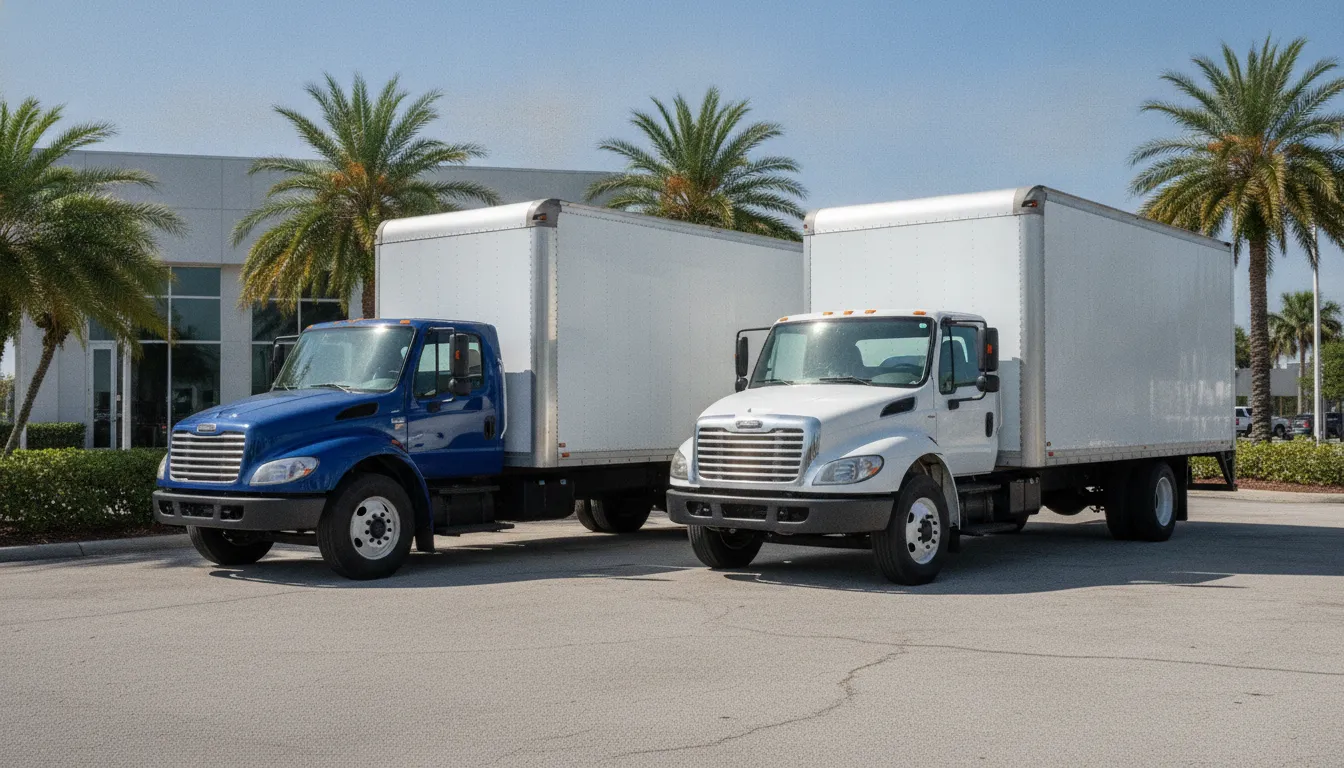
When a buyer searches for Hino 268 vs Freightliner M2, the useful answer is not that one name always wins. Both names cover medium-duty straight-truck families, and two used examples can differ more than the badges suggest. The better truck is the one whose route, body, payload, cab, and records match the work.
Compare current commercial trucks in Sanford and call DeBary Truck Sales at (407) 321-4244 before you plan a trip around a listing.
This guide is for fleet operators, contractors, and owner-operators who want a method they can use on a lot. It does not declare a winner, and it does not replace the door sticker on the truck you are looking at.
Start with the work, not the badge
Write the daily job down before you compare model pages. What is the normal load, and what is the heaviest realistic load? How many stops are on a usual day, and how far is the longest run? Will the truck see docks, tight streets, job sites, hills, or long idle time? A moving route, a parts route, and a contractor who hauls equipment are not shopping for the same truck, even when both candidates wear a 26-foot box.
Also write down who will actually drive it. If the plan depends on a driver without a commercial license, the weight rating is the first filter rather than a footnote. A trailer can change the license class even when the truck alone looks light enough. Separate the truck the business needs from the truck you are viewing. A well-kept chassis with the right body can beat a newer truck with the wrong wheelbase or a thin file.
DeBary Truck Sales is at 3400 West 1st Street in Sanford, Florida. The lot is built around used commercial trucks from more than one brand, which is what a fair side-by-side look needs.
Compare Hino 268 and Freightliner M2 configurations
Those names identify truck families, not one fixed specification. An older conventional Hino in this class was sold as the 268. Hino's legacy model page lists that truck at 25,950 pounds GVW, aimed at moving and delivery, with a Hino J08E engine at 230 horsepower and 520 pound-feet, and 260 horsepower offered. That page describes a past model sheet. It is not the rating of every used 268.
Newer Hino conventionals in this weight band are the L Series, Class 6 and Class 7, for applications from 23,000 to 33,000 pounds GVWR. Hino's model-year 2027 L6 and L7 sheet lists a Cummins B6.7 and an Allison automatic. It offers a day cab and an extended cab. GVWR bands include 23,000 to 25,950 pounds and a 33,000-pound truck. A used truck that still says 268 on the door can have the older Hino engine. Read the engine tag before you assume the newer powertrain.
The Freightliner side changes in the same way. The current M2 106 Plus is published as Class 6 through Class 8, with 200 to 360 horsepower, torque from 520 to 1,150 pound-feet, and GVWR up to 66,000 pounds. Freightliner lists Cummins B6.7 and Cummins L9 engines, Allison and Eaton transmissions, and day, extended, and crew cabs. A used M2 106 might be a light city truck or a much heavier chassis. The current ranges come from Freightliner's M2 106 Plus specifications. Those published ranges are a ceiling, not a promise about the truck in front of you.
For the rest of the Freightliner lineup, including Cascadia and severe-duty models, use the Freightliner buyer's guide. That page is a brand overview. This article stays on the head-to-head choice.
| Check. | Record it from. | Why it changes the choice. |
|---|---|---|
| GVWR and axle ratings. | The door sticker on that truck. | It sets legal load and the license question. |
| Engine and transmission. | The engine tag and build sheet. | Older Hinos and current trucks do not share one powertrain. |
| Wheelbase and cab-to-axle. | The spec sheet or a tape measure. | It decides whether the body and liftgate fit. |
| Body and add-ons. | Length, doors, liftgate, reefer, and shelving. | The body does the work, and it adds weight. |
| Curb weight as equipped. | A scale ticket with fuel and the driver. | Payload is what remains under GVWR. |
| Brakes. | Air or hydraulic, confirmed on the truck. | Air brakes can limit who may drive. |
| Cab. | Day, extended, or crew, plus seat condition. | It matters on long days and when two people ride. |
| Records. | Owners, invoices, rust, and wrecks. | A clean badge cannot replace a thin file. |
Leave a cell blank rather than borrowing a number from a new-truck brochure. A blank cell is a question for the seller. If you want live examples, start with used box trucks and used Freightliner trucks. Inventory changes, so confirm the specific unit before you travel.
Weight, payload, and the license line
Federal license rules sort vehicles by weight rather than by brand. The Federal Motor Carrier Safety Administration says a Class B commercial driver's license covers a single vehicle with a GVWR or gross vehicle weight of 26,001 pounds or more. The same class covers that vehicle towing a unit of 10,000 pounds or less. A Class A license covers a combination of 26,001 pounds or more when the towed unit is over 10,000 pounds. FMCSA explains the classes on its commercial driver's license driver page, and the groups are written in 49 CFR 383.91.
That is why 25,950 pounds shows up in this debate. It sits just under the 26,001-pound line for a single vehicle. Some older 268s were published at 25,950 pounds, and the current Hino L Series still offers a 23,000 to 25,950 pound band along with heavier trucks. An M2 can be spec'd under the line or far above it. You cannot tell which rating applies from the model name alone. Read the sticker, then ask whether the truck will be weighed in service, whether it will tow, and whether it has air brakes.
A driver who passed the skills test in a truck without air brakes can carry a restriction that blocks an air-brake truck. Passengers and hazardous materials add their own rules. A rating under 26,001 pounds does not clear every driver, every load, and every trailer. State and operation-specific rules can also apply.
Usable payload is the next math problem. Subtract the equipped curb weight from the GVWR. The body, liftgate, reefer, fuel, tools, and driver all count. Two 26-foot boxes with the same GVWR can have very different room left for cargo. For how a load must be held once it is on the truck, use the FMCSA cargo securement rules. If the seller cannot show a scale ticket, plan to weigh the truck before you buy.
- List the cargo, tools, driver, and passengers that normally ride along.
- Mark the heaviest realistic load and where that weight sits in the body.
- Read the ratings on this chassis, not a generic model description.
- Ask how the body and added equipment change empty weight and axle load.
- Get a qualified review when the load sits close to a rating.
Match the body, the cab, and the route
Choose the body for the freight first, then check it against the chassis. Record body length and width, the door opening, loading height, wheelbase, and rear overhang. A liftgate adds weight at the back. A reefer adds weight and a second system to maintain. Shelving and toolboxes count too. On either chassis, the same body type feels different on a different wheelbase. Longer can mean more floor and a harder dock. A shorter wheelbase can turn more easily and leave less cargo room.
If you are comparing a finished box with a cab and chassis, say so. One truck already has the working body. The other still needs a body installed. Do not assume a body will swap. Frame width, mounting points, wiring, clearance, and axle load all have to be confirmed by a qualified upfitter before that swap is part of the budget.
Cab shape becomes a daily operating cost. Current Hino L Series sheets list a day cab and an extended cab. The M2 106 Plus lists a day cab, an extended cab, and a crew cab, and Freightliner offers it as a straight truck or a tractor. A crew that rides with tools wants the extra seats. A solo city driver may prefer the shorter cab and an easier entry step. Freightliner also publishes up to a 55-degree wheel cut on the current M2 106 Plus. Treat that wheel-cut figure as a new-truck design goal. On a used truck, worn steering, body length, and rear overhang decide the turn you can make.
Have the primary driver climb in and out several times. Check the seat, the step, the mirrors, and the view at a simulated dock. A truck that looks right on paper and beats up the driver will not stay in service. Driver preference still has to be weighed against payload, body fit, and the service file.
Read the records before the reputation
Buyers often ask which truck is more reliable and which M2 years to avoid. A model does not have one reliability score you can bank, and a model year is not a diagnosis. Aftertreatment systems changed across the 2010s, and individual trucks were fixed, neglected, or left half-repaired. Ask for invoices that show dates, mileage or hours, and finished work. Look for completed emissions repairs, not a forum list.
Service access follows the engine that is actually in the truck. An older 268 may have a Hino engine. A newer L Series truck, and many M2 trucks, may have a Cummins, often with an Allison transmission. Ask who can work on that combination where the truck will run. Do not choose a badge because someone claimed one dealer network is always larger.
The file you want shows how many owners the truck had, whether it worked in fleet service, and whether services happened on schedule. It shows rust repair, frame work, and accident repair. Salt-belt history matters if the truck spent years on treated winter roads. DeBary specializes in one-owner, salt-free, rust-free trucks, does not buy auction trucks, and gives each listed truck a 31-point inspection before it is offered. Those points describe how this dealership sources trucks. It is not a promise that every truck on the market is clean, and it is not a substitute for the file on the unit you want.
Use the record review for one-owner trucks and the inspection checklist on whichever candidate you are serious about. An independent inspection is worth the cost when the paperwork is thin. During that look, note warning lights, leaks, tire wear, frame and body damage, liftgate operation, and signs of uneven loading.
Put the full job on one page
The purchase price is only one line in the decision. A better comparison includes the cost to make the truck ready, any body or equipment changes, tires, inspection items, and repairs the inspection already found. Do not invent a total before the truck and the work scope are confirmed. There is no universal winner between these two names. A 268 fits when that truck's rating, body, cab, and file match the route. An M2 fits when its truck does. If both trucks fail the job, walk away from both.
Financing terms can change the practical choice. Compare the amount, the term, and the truck you are actually buying, not a guess from a lower sticker. Buyers can review commercial truck financing after the truck fits. If the truck you already own is the loser, ask about a trade-in instead of forcing a bad match to stay in the fleet.
For a wider shopping frame, the used-truck buying guide and the notes on a commercial truck for a small business sit next to this comparison. Delivery fleets can also use the delivery-truck selection guide. None of those pages makes this head-to-head choice for you.
When you are ready to look at real trucks, call (407) 321-4244 or review the Sanford inventory. Confirm the listing, the equipment, and the records before you buy.
Frequently asked questions
Is a Hino better than a Freightliner?
No brand wins every job. Compare the GVWR, body, cab, service access, and records on the two trucks you can actually buy. A clean, correctly rated truck beats a famous badge with a thin file.
Does a Hino 268 always avoid a CDL?
No. FMCSA sets Class B at 26,001 pounds GVWR or gross vehicle weight for a single vehicle. Some 268s were built at 25,950 pounds, and some Hino and Freightliner trucks in this class are rated higher. Read the door sticker, and account for air brakes and any trailer. State and operation-specific rules can also apply.
How should a buyer judge reliability?
Use records, not a model reputation. Look for on-time service, finished emissions repairs, and a frame and body that match the story. One careful owner can outweigh a truck that was run hard and patched.
Which Freightliner M2 years should buyers avoid?
Do not shop from a banned-year list. Emissions hardware changed over time, but a specific truck was either maintained or it was not. Ask for invoices and inspect the aftertreatment system on that truck.
What is the most reliable 26-foot box truck?
The most reliable one is the truck whose rating, body, and file match your route. Box length does not make a truck reliable. Condition, correct loading, and service access do.
Filed under: Blog Articles


